
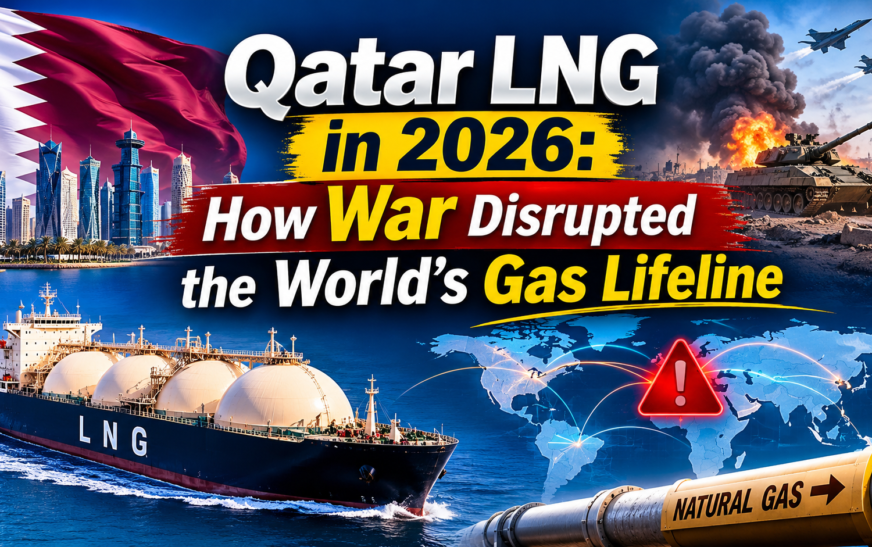
For years, Qatar LNG has been one of the quiet foundations of the global energy system. Ships carrying super-cooled gas leave the Gulf for power stations, factories and homes in Asia and Europe, often without making headlines. In 2026, that changed. A regional war put the country’s gas industry directly in the line of fire, and the effects were felt in energy markets far from the Gulf.
This article explains why Qatar matters so much to gas supply, what happened to its facilities this year, and what the recovery and expansion plans look like.
Why Qatar LNG matters
Liquefied natural gas, or LNG, is gas cooled into a liquid so it can travel by ship. Qatar is one of the biggest names in this trade. The country produces roughly 20% of the world’s LNG. The US Energy Information Administration has described Qatar as the world’s second-largest LNG exporter in 2024, with about a fifth of global exports. ogjnoonpost
Most of that gas is processed and loaded at Ras Laffan Industrial City on the northeast coast. On paper, Ras Laffan is the largest LNG export complex in the world, with 14 liquefaction trains. Its nameplate capacity is about 77.1 million tonnes per year. gettransportgettransport
The gas comes from the North Field, one of the largest gas fields on Earth. Its recoverable reserves exceed 900 trillion standard cubic feet, roughly 10% of known global reserves. Because so many buyers depend on Qatari cargoes under long-term contracts, any disruption travels quickly through the market. oedigital
What happened to Ras Laffan
The shock came in March 2026. According to industry reporting, QatarEnergy halted LNG production and declared force majeure after Iranian missile attacks on Ras Laffan Industrial City. Force majeure is a legal step that lets a supplier pause delivery obligations when events outside its control prevent it from shipping. ogj
Early estimates showed the scale of the problem. Within days, reports said Qatar’s LNG exports had fallen 17% after the strikes, with a revenue loss of around $20 billion expected. oedigital
The damage to the plant itself proved lasting. By May, industry assessments suggested that repairs to major parts of the infrastructure could take three to five years, with the loss of Trains 4 and 6 removing roughly 12.8 million tonnes per year of capacity. One industry review puts the usable capacity at around 64.3 million tonnes per year after the March strikes. ogjgettransport
In June, there was another setback. QatarEnergy confirmed an explosion and fire at its LNG operations in Ras Laffan on June 21 and said it was investigating. ogj
Shipping risk added to the problem. Tensions around the Strait of Hormuz, the narrow waterway through which Gulf LNG must pass, made cargo movements uncertain. Regional tensions disrupted both output and exports. euronews
The financial cost
The numbers are large. One market report estimated that Qatar lost about $24 billion in gas sales after the war cut its LNG exports by as much as 96%. Figures like this are estimates and can change as more data arrives, but they show how heavily the Qatari economy depends on gas. oilprice
The change is sharp when compared with earlier forecasts. Before the conflict, analysts expected a very different year. One 2025 outlook projected Qatar’s GDP growth to nearly double to 4.8% in 2026, driven by the North Field expansion. The war has made those pre-conflict projections look very optimistic. gulf-times
How Qatar responded
Qatar moved on several fronts to protect its customers and its revenue.
Buying gas elsewhere. To keep supplying Asian buyers, Qatar turned to other producers. It bought 33 US LNG cargoes this year to supply Asian customers after the damage cut its own Ras Laffan output. This shows how serious the shortfall was, since one of the world’s top producers had to purchase gas to meet its own contracts. oilprice
Restarting exports in phases. By late June, signs of recovery appeared. Empty LNG tankers gathered off Ras Laffan as exports edged back toward normal, even though a force majeure declaration remained in place. By September, reports described Qatar increasing LNG shipping through Hormuz again. oilpricestrategicenergymap
Repairing the plant. Restoring damaged trains is a slow, expensive job, and a full recovery depends on both repairs and the security situation in the Gulf.
The North Field expansion
Despite the disruption, Qatar has not abandoned its long-term plan. Its expansion strategy aims to lift capacity from 77 million tonnes per year to 142 million tonnes per year once all phases are complete. The project has three parts: North Field East (32 million tonnes), North Field South (16 million tonnes) and North Field West. pulseoedigital
Work has continued during the crisis. In February, QatarEnergy awarded the main construction contract for the onshore plant of North Field West to a joint venture including Technip Energies. In April, US-based Baker Hughes won a major equipment contract for the project, even as Hormuz disruptions continued. oedigitalpulse
Timing, however, looks less certain than before. First output from North Field East was once expected in mid-2026. More recently, international oil companies said a start by early 2027 was still possible, depending on how the conflict develops. pulse
What to watch next
Several questions will decide where Qatar LNG goes from here:
- Security in the Gulf. Safe passage through the Strait of Hormuz is essential for every cargo.
- Repair progress. Whether damaged trains return in months or years will shape Qatar’s real capacity.
- Force majeure status. Buyers will watch for when Qatar can fully return to its contract commitments.
- Buyer behaviour. Importers in Asia and Europe may spread their supply across more sellers, including the United States.
- Expansion timing. Any delay to North Field East and the later phases would affect global gas supply in the years ahead.
The bottom line
Qatar LNG is a reminder that energy security depends on a small number of places and a few narrow shipping routes. The 2026 conflict showed how quickly a regional war can turn into a global market story. Qatar still holds enormous reserves and still plans to grow, but the path back to full output will depend on repairs, security and the wider political situation in the Gulf. For gas buyers around the world, the region will stay at the centre of attention.
Note: This report is based on published reporting and industry estimates, which may change as new information emerges.